

What is TF-IDF… Can it read documents with just one word?
TF-IDF is a fundamental technique for determining important words within a document to understand the meaning of the text.
Roy
Is “apple” really an important word?
When reading a document, we quickly grasp the gist of the text by looking at the title or the first sentence. Computers do something similar: they look at words to determine what a document is about. However, not all words are equally important.
For example, in the sentence “I want to eat a banana,” the word “banana” feels more important than words like “I” or “want,” right?
There’s a technology that helps computers understand this too. That’s TF-IDF.
🍌 In simple terms, TF-IDF is a “word importance calculator.”
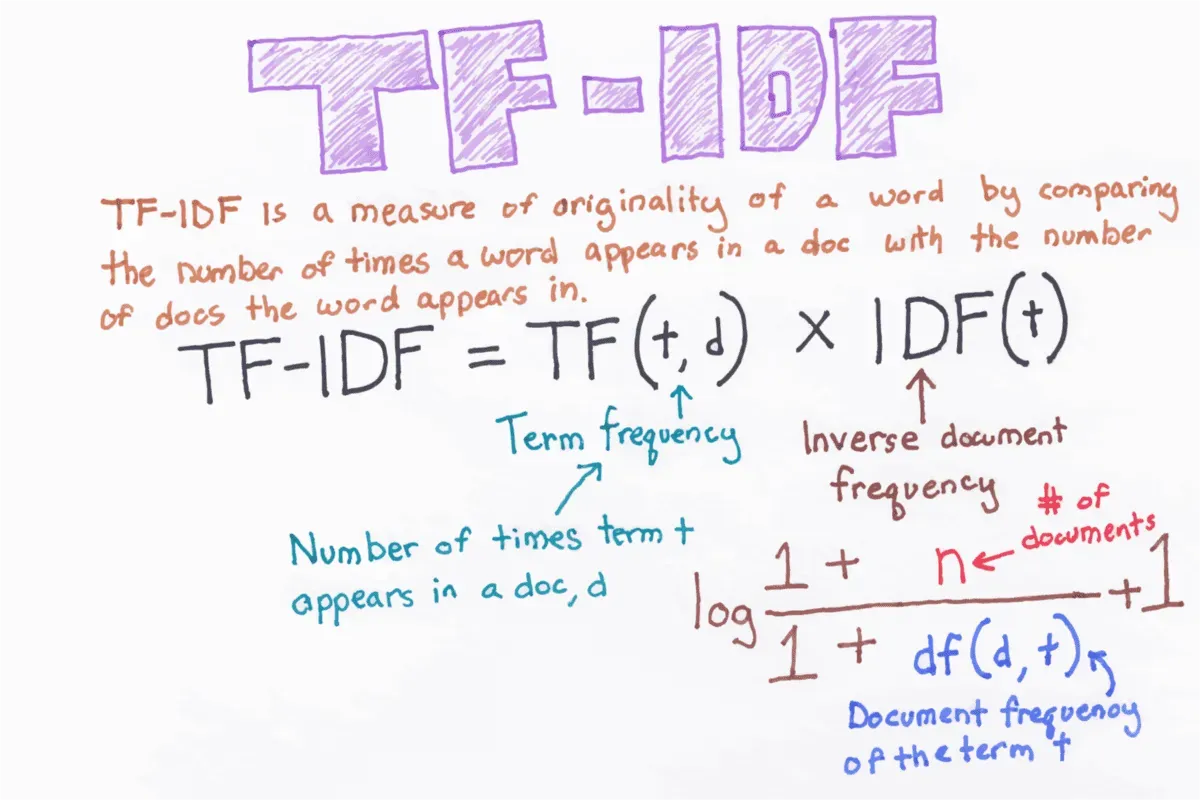
TF-IDF stands for Term Frequency - Inverse Document Frequency. It sounds complicated, but here's a simple explanation:
“Words that appear frequently, but only in this document, are the most important!”
If a word appears multiple times in a document → It is considered important in that document
But if that word appears in multiple documents? → It's just a common word and not considered important
🍎 Learning TF, DF, and IDF with examples
▶ TF (Term Frequency)
This looks at how many times a word appears in a document.
Document Content
Document 1 I want to eat an apple.
Document 2 I want to eat a banana.
Here, “eat” appears once in both documents, right?
“Banana” only appears in Document 2. Therefore, “banana” could be a more important word in Document 2.
▶ DF (Document Frequency)
This measures how many documents a word appears in.
“Eat” appears in both Document 1 and Document 2, so DF = 2.
“Banana” only appears in Document 2, so DF = 1.
▶ IDF (Inverse Document Frequency)
IDF is the opposite of DF!
Words that appear in many documents are common, so they are less important.
Words that appear in only a few documents are rare, so they are more important!
The IDF formula looks like this, but don't worry too much. We just need to interpret it.
IDF(t) = log(total number of documents / (number of documents containing the word + 1))
For example, if there are 4 documents in total and “apple” appears in only 1 document:
IDF = log(4 / (1 + 1)) = log(2) ≈ 0.693
🍇 So what is TF-IDF?
Now we're all set.
TF × IDF = TF-IDF
In other words, we multiply how often a word appears in a document (TF) by how rare the word is (IDF)
to find the truly “important words.”
🥝 Real-world example: Is banana really important?
The table below shows the number of times each word appears in each document (TF). (This is also called DTM.)
- Document 1
Banana: 0
Eat: 1 - Document 2
Banana: 1
Eat: 1 - Document 3
Banana: 2
Eat: 1
Now, let's calculate TF-IDF by multiplying the IDF values.
In Document 2, “banana” appears once, so TF = 1.
In Document 3, it appears twice, so TF = 2.
Let's assume that IDF is 0.287682 in both cases.
So:
Document 2: 1 × 0.287682 = 0.287682
Document 3: 2 × 0.287682 = 0.575364
Even if it's the same word, Document 3, where it appears more often, is considered more “important”!
🤖 Where is TF-IDF used?
Search engines: When you search for “I want to eat an apple,” documents with high TF-IDF scores are displayed first.
- Document classification: When distinguishing whether a document is a “sports article” or “entertainment news”
- Chatbots: When extracting important keywords from user questions
And it's no exaggeration to say that almost all the basics AI uses to understand text these days start with TF-IDF.
🚀 In conclusion: TF-IDF is a technology that assigns scores to words!
You may feel like you've seen too much information, but just remember one thing.
TF-IDF is a technology that tells you “how special this word is” in numbers.
When analyzing documents or building AI models in the future, using TF-IDF can enable smarter analysis.
Now, we’re one step closer to creating AI that can “read” documents through TF-IDF!
💡 Preview of Next Content
“What’s Next After TF-IDF?” — Methods for Calculating Document Similarity
“Building Your Own Search Engine: Let’s Start with TF-IDF!”
“Beyond TF-IDF… How Does BERT, a Deep Learning-Based Model, Understand Words?”
Reference: https://wikidocs.net/31698